
The PSTN and ISDN Switch-Off: What UK Businesses Need to Do Before 2027
Executive Summary
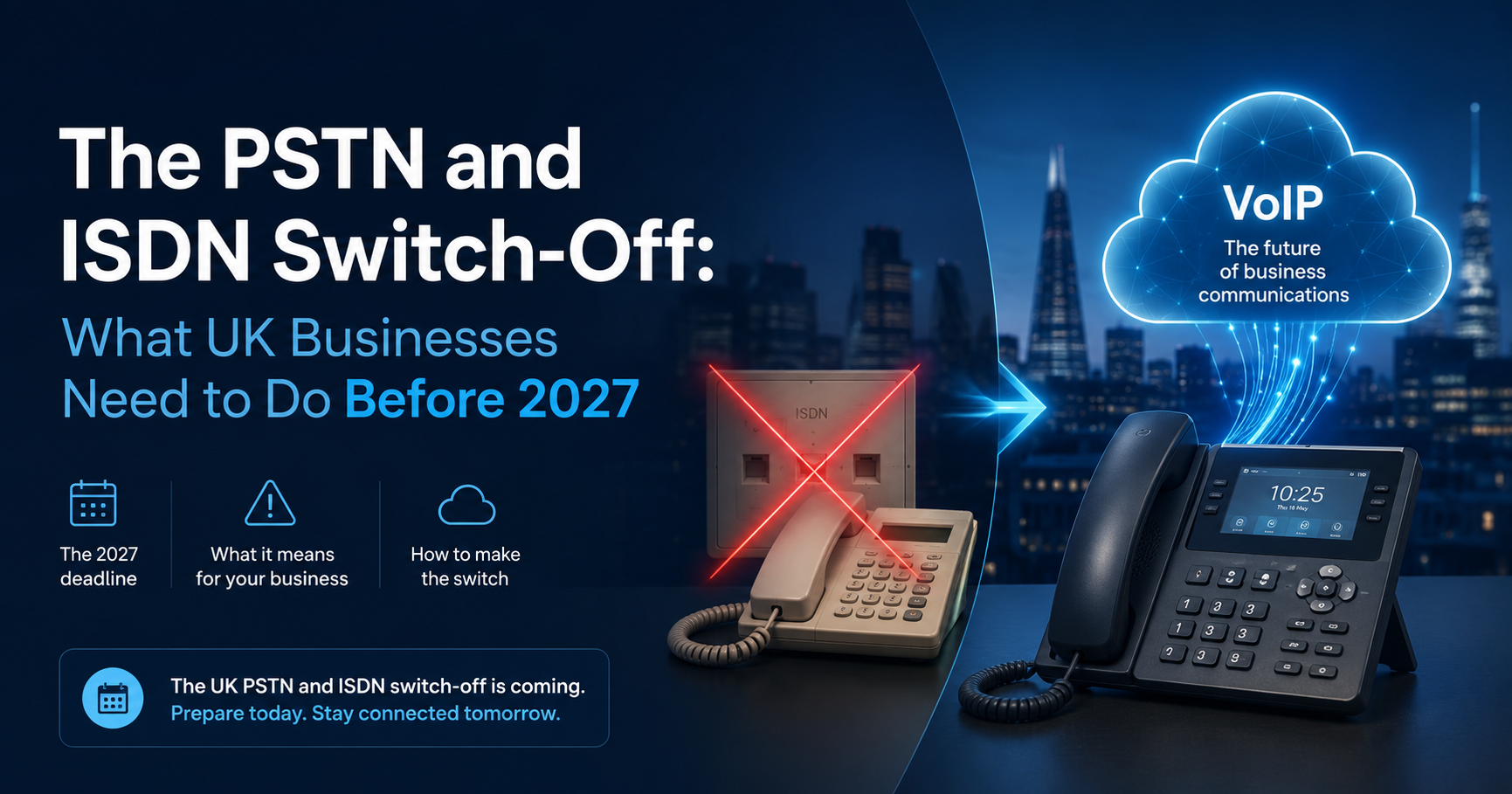
The UK’s traditional phone network is being switched off, with legacy PSTN and ISDN services scheduled to be withdrawn by 31 January 2027.
While many businesses assume this only affects office telephones, the reality is often much broader. Alarm systems, payment terminals, entry systems, CCTV monitoring and even some broadband connections may still rely on legacy phone lines.
The good news is that there is still time to prepare. By understanding what services could be affected and planning ahead, businesses can avoid disruption and ensure a smooth transition to modern digital communications.
Introduction
If you’ve heard about the PSTN and ISDN switch-off, you may have assumed it was simply a telecoms issue or something that only affects larger organisations.
In reality, every UK business should consider whether any phone, security, payment or connectivity services still rely on legacy infrastructure.
Many businesses still have systems quietly running in the background that depend on traditional phone lines. In some cases, owners and managers are completely unaware these connections exist until a supplier raises the issue or a service stops working.
With the final switch-off approaching on 31 January 2027, now is a good time to review your technology and ensure your business is prepared.
What Are PSTN and ISDN?
PSTN stands for Public Switched Telephone Network. It is the traditional analogue phone network that has been used across the UK for decades.
ISDN, or Integrated Services Digital Network, is an older digital telephone service that has been widely used by businesses for voice and data communications.
Both technologies have served businesses well for many years, but the infrastructure behind them is ageing and becoming increasingly difficult to maintain. The UK telecoms industry is therefore moving away from legacy analogue and ISDN services towards modern digital communications.
In practice, this means voice services will increasingly operate over an internet connection rather than the legacy analogue phone network.
This transition is often referred to as the move to Digital Voice, Voice over Internet Protocol, or VoIP.
It is worth noting that the switch-off is not limited only to standard Openreach phone lines. Some providers use their own equipment in local exchanges through arrangements such as local loop unbundling, or LLU. However, where a service still depends on legacy copper, analogue voice or PSTN-style signalling, it may still be affected and should be reviewed with the provider.
The UK’s legacy PSTN and ISDN services are expected to be withdrawn by 31 January 2027, so businesses should identify and migrate any affected services before that deadline.
Why Is the Switch-Off Happening?
The UK’s telecoms infrastructure has changed significantly over the past two decades.
Most businesses now rely heavily on internet connectivity, cloud applications, video meetings and flexible working arrangements. Traditional phone networks were not designed for these modern requirements.
By moving to digital services, communication providers can deliver more flexible and feature-rich solutions while retiring older infrastructure that is becoming more expensive and challenging to support.
For businesses, this shift is part of a wider move towards modern, cloud-based technology.
What Could Be Affected in Your Business?
This is where many organisations are surprised.
The switch-off is not simply about replacing desk phones. A wide range of business systems may still be using PSTN or ISDN services behind the scenes.
Business Phone Systems
The most obvious area is your phone system.
If your organisation uses an older on-premise PBX or ISDN-based phone system, it may need to be upgraded or replaced with a digital solution before the switch-off.
Alarm Systems
Many intruder alarms use traditional phone lines to communicate with monitoring centres.
If these connections are not updated, alarm signals may no longer function as expected once legacy services are withdrawn.
CCTV and Security Monitoring
Some CCTV systems and remote monitoring services rely on older telephone connections for alerts and communications.
These systems should be reviewed to ensure they remain operational after the transition.
Payment Terminals
Certain card payment machines still use telephone line connections.
While many modern terminals already use broadband or mobile networks, it is worth confirming that your equipment is compatible with digital services.
Door Entry and Access Control Systems
Some intercoms, gate entry systems and access control solutions may depend on PSTN-based communications.
These systems can often be overlooked during planning.
Lift Emergency Phones
Emergency communication systems installed in lifts may also require upgrades or modifications.
Building owners and facilities managers should ensure these systems are assessed well before the deadline.
Broadband Services
Some broadband services are still tied to legacy copper or phone-line products. Depending on the provider and service type, businesses may need to move to alternatives such as full fibre, SoGEA, Ethernet, 4G/5G backup or another IP-based service.
This does not mean that all broadband is being switched off. Rather, businesses should check whether any current broadband service depends on legacy phone-line infrastructure or forms part of a service that will be withdrawn.
This is particularly important where broadband supports business-critical systems such as card payment terminals, alarm signalling, CCTV, remote monitoring, hosted phones or cloud applications.
Businesses should also consider power and connectivity resilience. Digital voice and alarm-signalling services may depend on broadband routers, network equipment and local power, so backup arrangements may be needed for critical services.
How Do You Know If Your Business Is Affected?
The challenge is that many affected systems are not immediately obvious.
A good starting point is to ask a few simple questions:
- Do we still have traditional phone lines on-site?
- How old is our phone system?
- Are any alarms, payment terminals or security systems connected to telephone sockets?
- Have any suppliers mentioned the PSTN or ISDN switch-off?
- Do we know how all of our critical systems communicate?
If you’re unsure of the answers, it may be worth carrying out a technology review with your IT provider and relevant suppliers.
The earlier you identify any dependencies, the easier it will be to plan upgrades and avoid last-minute surprises.
Why You Shouldn’t Leave It Until the Last Minute
Although 31 January 2027 may sound some way off, delaying action can create unnecessary risk.
As more businesses begin migrating away from legacy services, demand for replacement solutions and engineering resources is likely to increase.
Leaving preparations too late could result in:
- Increased project costs
- Longer lead times
- Greater risk of disruption
- Limited choice of replacement solutions
- Unnecessary pressure on internal teams
Planning ahead allows businesses to spread costs, test new systems properly and make informed decisions rather than rushing into changes.
Final Thoughts
The PSTN and ISDN switch-off is one of the most significant changes to UK communications infrastructure in recent years.
While it may initially sound like a telecoms issue, the reality is that it can affect a wide range of business-critical systems. From phones and alarms to payment terminals and security systems, it is important to understand what relies on legacy connections before the switch-off takes place.
Businesses that review their systems early and develop a clear migration plan are likely to experience a far smoother transition.
Not Sure Whether Your Business Is Affected?
If you’re unsure whether your phones, alarms, internet connection or other business systems rely on PSTN or ISDN services, Get Support can help.
Our team can assess your current setup, identify any services that may be affected by the 31 January 2027 switch-off, and help you plan a smooth transition with minimal disruption to your business. Whether you need advice, upgrades, supplier coordination or ongoing IT support, we’re here to help.
FAQs
The UK’s legacy PSTN and ISDN services are scheduled to be withdrawn by 31 January 2027. Businesses should begin planning well before this deadline to avoid disruption.
No. While phone systems are the most obvious area, other services such as alarms, CCTV monitoring, payment terminals, lift emergency phones and entry systems may also be affected.
Check with your telecoms provider, review your current phone system and identify any equipment connected to traditional telephone sockets. An IT assessment can also help uncover hidden dependencies.
Not necessarily. Some systems may only require reconfiguration or minor upgrades, while others may need replacing. The exact requirements depend on your current setup.
Get Support can review your existing infrastructure, identify any systems affected by the PSTN and ISDN switch-off, recommend suitable solutions and help manage the transition from start to finish.